

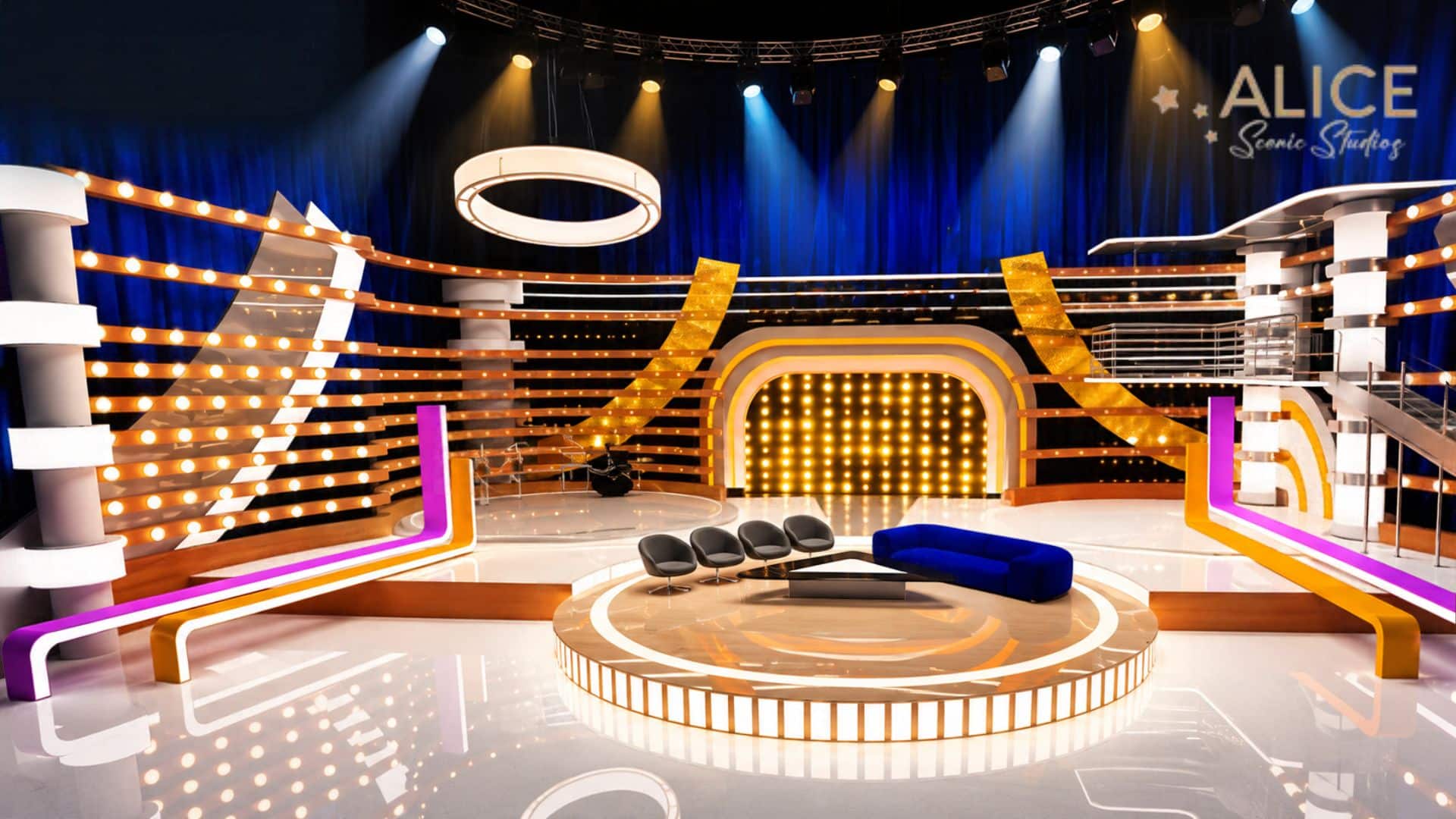
How Fabrication Precision Influences the Look and Performance of Television Sets
A TV set has one job before anyone speaks. It must show viewers what the show is about. On screen, small flaws appear fast. A loose joint, an uneven finish, or a poorly integrated light fixture can pull attention away from the content. That is why broadcast scenic fabrication needs more care than most builds.
At Alice Scenic Studios, we fabricate studio environments for broadcast and live production, working from our clients’ designs and technical requirements. In this blog, you will learn how precision shapes the look of a set, how it helps a set perform, and what to look for in a fabrication partner.
How Does Fabrication Precision Affect Television Studio Sets?
Precision affects two things at once: how a set looks and how it works.
- Look on camera: Clean lines, tight joints, and smooth finishes read as polished on screen.
- Performance on the floor: Well-built frames and structures are better able to hold up under daily production schedules.
- Brand identity: Logos, lettering, and backlit panels only work when they are cut, fitted, and installed accurately.
- Technical readiness: Cutouts, mounting points, and cable routes can be built to match the client’s lighting, LED wall, and AV specifications.
When these parts line up, the set looks good and runs more smoothly. That is the goal of precision TV set fabrication.
Why Is Precision Important in Broadcast Scenic Fabrication?
A TV set is not a stage seen from far away. Cameras get close, and many sets are now viewed on 4K screens, so edges and surfaces are on show.
- Cameras show detail: Flaws that are easy to miss in person can stand out on screen.
- Production runs daily: A set needs to stay stable and look consistent from one day to the next.
- Live shows leave little room for fixes: Problems found on the day cost time and money.
- Many teams share the space: Producers, directors, and technical leads all depend on the set matching the plan.
Precision at the start reduces effort later. A well-built set lets crews focus on the show, because the structure, finishes, and integration points were built to the agreed drawings.
Read more about how broadcast scenic fabrication transforms studio sets to explore how fabrication techniques contribute to a studio’s visual impact and practical performance.
How Are Television Sets Fabricated for Cameras and Lighting?
Good sets are planned around the camera and the lights. Our role is to turn your design and technical requirements into an accurate, buildable set. Here is how that process typically works.
Step 1: Production Drawings and Technical Coordination
Most projects reach us with a design from the client’s set designer, architect, or production team. We work with your producers, set designers, and technical leads to understand the show format, camera positions, and technical requirements before production starts.
Explore the television studio set design and fabrication process for additional insight into how a studio project moves from planning to construction.
- Production drawings: We prepare AutoCAD production drawings and, where needed, 3D models, so dimensions and structural details are reviewed and agreed before fabrication begins. The level of documentation depends on what the project requires.
- Coordination with your technical team: Lighting positions, LED wall locations, and AV routes are defined by your designers and engineers. We coordinate with them so the fabricated set accommodates those requirements.
- Modular planning: Where the project calls for it, sets can be built to reconfigure between show formats.
- Design support: On selected projects, we can also support concept and visual development. This is offered when it is part of the agreed scope.
Step 2: Build for the Camera and the Floor
Next, we fabricate everything from structural framing to fine surface details. Explore our custom scenic fabrication capabilities to learn how coordinated craftsmanship helps bring complex studio designs to life.
Our custom scenic fabrication capabilities include:
- Precision carpentry and millwork: Our 10,000 sq ft carpentry facility uses CNC machining, including 5-axis capability, to shape wood and composite materials accurately.
- Metal structures and supports: We make custom metal frames, desk structures, and rigging supports for durability and load-bearing strength, built to the project’s engineering requirements.
- Scenic paint and custom finishes: Layered surface treatments add texture, depth, and a finish designed to work on screen.
- Graphics and dimensional signage: Channel branding, logos, dimensional lettering, and backlit panels can be produced and installed as part of the build.
- Integration with technical systems: Where the project requires it, we build in provisions for LED, lighting, and broadcast equipment to the client’s specifications, so these elements are not an afterthought.
This is how broadcast scenic fabrication turns a design on paper into a set that is ready for your technical teams.
Sets for Every Format
Different shows need different sets. Our broadcast studio set fabrication can be applied to a range of formats:
- Anchor desks and news sets
- Multi-camera setups for live sports
- Builds for eSports and live events, where assembly speed matters
- Studio environments for corporate video teams
Installation, Strike, and Support
When included in the project scope, our team can provide on-site installation and assembly, working alongside your technical crew. Services such as format changes and strike at the end of production are also available when agreed as part of the project.
The exact services, from installation through to strike and later support, are defined project by project, so we recommend confirming them at the start.
Why Our Production Model Helps
We use a “U.S. managed, Turkey-produced” model. U.S.-based project management oversees the work, while fabrication takes place at our production facilities in Turkey. This approach can keep pricing competitive and turnaround quick, even with shipping, though results vary with project size and schedule.
It also means direct communication with a U.S.-based team from planning through to handover. We work with clients in Miami, Orlando, Tampa, and New York.
Final Thoughts
Precision is what makes a TV set look sharp on screen and work well behind the scenes. Accurate production drawings, careful fabrication, quality finishes, and coordination with your technical team all help your show look its best. If you want a set that is built accurately to your design and specifications, our team can help. Our precision TV set fabrication and custom scenic fabrication cover fabrication and, where included in your scope, installation.
Explore our broadcast scenic fabrication services, or contact Alice Scenic Studios to talk through your next studio project.
Frequently Asked Questions
1. What makes a professionally fabricated TV set look better on camera?
Clean lines, tight joints, and smooth finishes make a difference on camera. Layered paint and surface treatments add texture and depth. When lighting, LED, and AV requirements are coordinated with the fabrication team early, those elements can be integrated cleanly. Together, these details help a set hold up on high-resolution screens.
2. Can a TV set be reconfigured for different show formats?
Yes, where it is planned from the start. We can fabricate modular and reconfigurable set pieces designed to change between show formats, which can save time and cost. Format changes and strike services are available when included in the project scope.
3. Do you build sets for eSports and live events?
Yes. Our eSports and live event builds focus on bold visual presence and efficient assembly. We build structures that accommodate the client’s LED, lighting, and broadcast equipment.
4. Do you support the set after it is installed?
It depends on the project. Where included in the scope, we provide on-site installation, coordinate with your technical crew, and offer strike services when production wraps. We recommend agreeing these services at the start.
5. Who do you build TV sets for?
We work with local broadcasters, national networks, eSports companies, and corporate video teams. Our work includes anchor desks for news channels and multi-camera setups for live sports, as well as builds for eSports and live events.