

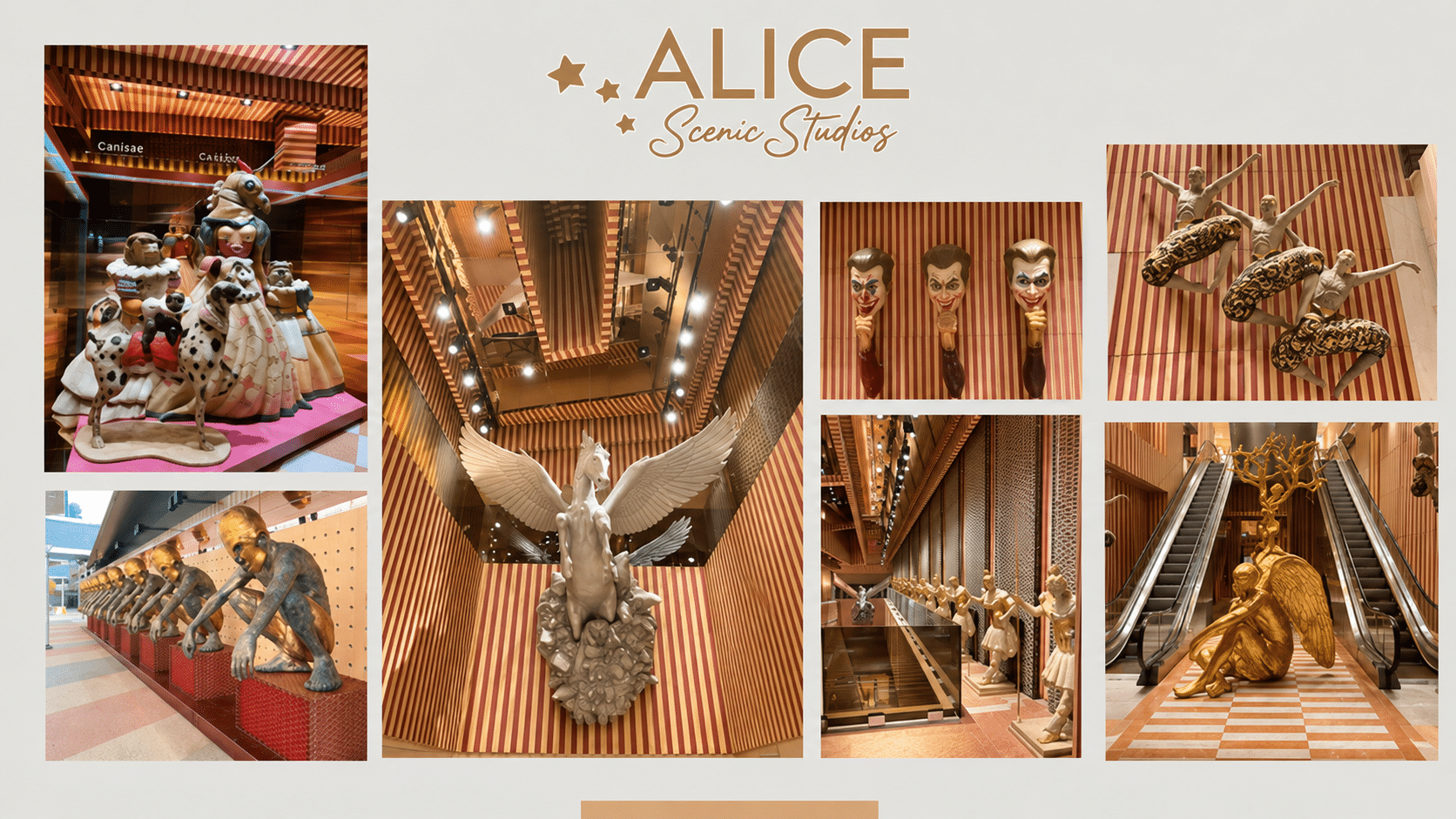
Why Fiberglass Is a Popular Choice for Large 3D Sculptures
Make a sculpture big enough to tower over a plaza, and every material choice gets harder. It has to carry its own weight, handle weather, travel to the site, and still look sharp up close. That is why fiberglass fabrication for large 3D sculptures is such a common answer for theme parks, museums, and public spaces.
Here are the reasons designers and project teams keep choosing it.
Reason 1: It Is Strong but Not Heavy
Size and weight usually grow together. Fiberglass, also called FRP (fiberglass-reinforced plastic), helps break that link.
- Lightweight shells are easier to lift, move, and mount than many solid alternatives.
- Strong internal armatures give large figures the support they need.
- Lower weight can make installation on rooftops, facades, and display bases more practical.
- Structural fiberglass components can also be built to meet load, safety, and longevity requirements for theme park use.
Reason 2: It Is Made for Outdoor Life
Large pieces often live outside, facing sun, rain, and daily crowds. FRP is known for being weather-resistant, which is why it appears in so many outdoor projects.
- Fiberglass pieces can be designed for long-term outdoor use without warping, fading, or structural failure.
- Protective surface coatings add another layer between the sculpture and the weather.
- Plazas, parks, and holiday installations all rely on this kind of resilience.
Actual lifespan always depends on climate, finish, design, and upkeep.
Outdoor attraction projects require careful consideration of material strength, surface protection, and long-term exposure, as explained in this guide to fiberglass fabrication for outdoor attractions.
Reason 3: It Can Capture Complex Shapes
Curved wings, flowing hair, rock textures, and expressive faces are hard to carve from a single block. This is where fiberglass fabrication for large 3D sculptures has a clear advantage, because it starts with a mold rather than a solid block.
- 3D modeling, CNC-milled master patterns, and 3D-printed models help the mold capture every curve and dimension as designed.
- EPS foam carving with an FRP shell coating can shape large forms efficiently.
- Polyurethane and polyester casting can add rigid or flexible components with strong surface detail.
- Complex organic forms, such as characters, trees, and rock formations, suit this process well.
Reason 4: It Takes Paint and Texture Beautifully
A sculpture is judged by its surface. Fiberglass offers a smooth base that accepts a wide range of finishes.
- Polycoating and gel coat build a protective, paint-ready surface.
- Hand-painted scenic finishes add color accuracy, depth, and texture.
- Weathered patinas can make a piece look aged, metallic, or stone-like without using those heavy materials.
- The result can look sharp from across a plaza and still hold up when guests walk right up to it.
Reason 5: Molds Make Repeats Practical
Some projects need one hero piece. Others need a whole family of them.
- A precision mold can produce consistent results across single pieces or large production runs.
- Multi-use molds are engineered for repeated use without a drop in surface quality.
- Matching figures, repeating architectural details, and themed sets benefit from this consistency.
Reason 6: You Can Test Before You Commit
Large sculptures are expensive to rework. Prototyping brings problems to the surface early.
- A physical prototype, for selected projects, lets clients approve form, surface detail, and scale before a full run.
- Early review can save time and help avoid revisions in the middle of production.
- Digital tools, such as CNC milling and 3D printing, help turn the design file into a production-ready mold.
Reason 7: Big Pieces Can Ship in Sections
A sculpture is only useful if it reaches the site in good shape. Fiberglass pieces can be planned with logistics in mind.
- Large elements can be engineered to break down into manageable sections.
- Sections pack efficiently and reassemble cleanly on site.
- Planning joints and seams early helps the finished piece look continuous once installed.
Reason 8: It Works Across Many Project Types
Fiberglass is not limited to one kind of sculpture. That flexibility is part of why it is so widely used.
- Character and figure sculptures, from lifelike to stylized.
- Architectural facades and decorative panels for themed spaces, retail, and hospitality.
- Ride and attraction elements for theme parks.
- Urban furniture and outdoor installations.
- Museum environments and holiday displays.
Through custom fiberglass fabrication, each piece can be shaped around the weight, durability, and finish needs of the place it will live.
A Quick Look at How a Large Piece Is Made
Understanding the process shows why the material works so well at scale. A path looks like this:
- Concept and modeling: The design is developed and refined in 3D.
- Master pattern: The form is created through CNC milling, 3D printing, or foam carving.
- Prototype review: A physical test piece is approved for form, detail, and scale. (for selected projects)
- Mold making: A precise mold is built from the master pattern.
- FRP layup or casting: Fiberglass layers or cast components form the shell.
- Finishing: Gel coat, polycoating, and scenic paint complete the surface.
- Sectioning, shipping, and assembly: Large pieces are packed in sections and reassembled on site.
This is the workflow behind fiberglass fabrication for large 3D sculptures, and it is the same basic path whether the project is a single character or a full themed zone.
The same combination of material selection, detailed fabrication, and careful finishing is important when producing durable large-scale attractions designed to withstand demanding environments.
Final Thoughts
Fiberglass earns its place in large-scale sculpture because it balances strength, low weight, fine detail, and finish quality. When the process starts with a strong plan and a tested prototype for complex projects, the result can be a piece that suits its setting and its audience.
If you are planning a character sculpture, a themed facade, or an outdoor installation, Alice Scenic Studios is ready to talk. Explore our fiberglass fabrication for large 3D sculptures, or contact us to discuss your next project.
Frequently Asked Questions
1. Why is fiberglass commonly used for large-scale sculptures?
Fiberglass combines strength with relatively low weight, which makes large forms easier to build, ship, and install. It also takes detailed molds well and accepts a wide range of paint finishes. For these reasons, fiberglass fabrication for large 3D sculptures is a common choice for theme parks, museums, and public spaces.
2. What are the benefits of fiberglass sculptures for theme parks?
Theme parks need pieces that can handle crowds, weather, and repeated use while still looking polished. Fiberglass offers lighter weight, strong surface detail, paintable finishes, and the option to repeat pieces from a single mold. Structural FRP elements can also be built to meet load, safety, and longevity requirements. With custom fiberglass fabrication, weight, durability, and finish can be matched to the specific attraction.
3. How durable are fiberglass sculptures for outdoor installations?
Fiberglass is designed for long-term outdoor use and is often chosen because it can resist warping and fading. Protective coatings such as gel coat and polycoating, along with scenic paint finishes, help surfaces hold up outdoors. Actual durability depends on climate, design, finishes, and maintenance.
4. How are large fiberglass sculptures manufactured?
The process usually begins with 3D modeling and a master pattern made through CNC milling, 3D printing, or foam carving. A prototype is reviewed, and then a mold is built. Fiberglass layers or cast components form the shell, and the surface is finished with gel coat, polycoating, and scenic paint. This sequence is central to fiberglass fabrication for large 3D sculptures, and large pieces are often built in sections so they can be shipped and assembled on site.
5. How are large FRP pieces shipped and installed on site?
Large elements are engineered to break down into manageable sections, pack efficiently, and reassemble cleanly at the destination. Alice Scenic Studios installation teams handle on-site assembly across the U.S. Planning the joints, packing, and installation route early helps each piece arrive and fit as intended.